Most people upgrading their coffee setup skip straight to a grinder or a bag of single-origin beans and never look twice at the machine dripping water over the grounds. That's a mistake, because a drip brewer that can't hold a steady water temperature will under-extract a great bean just as reliably as it under-extracts a mediocre one. There's a real certification behind the machines that get this right, and most shoppers have never heard of it.
What SCA Certification Actually Tests
The Specialty Coffee Association runs a Certified Home Brewer program built around its Golden Cup Standard, and it's more specific than most buyers assume. A certified machine has to hold water between roughly 195°F and 205°F for the entire brew cycle, finish a full carafe in a proportional 4-to-8-minute window, and distribute water evenly enough across the grounds to hit a uniformity score of at least 60 out of 100. Pass all of that and a brewer earns SCA certification, which functions as a genuinely useful shortcut: it's independent, third-party confirmation that the machine isn't quietly under-extracting every pot it makes.
Two Certified Brewers, Two Very Different Price Tags
Bonavita BV1900TS: The Value Case for Certification
Start here if price is a real factor, because the Bonavita earns the same SCA certification as the far pricier Moccamaster and brews to the identical Golden Cup temperature standard, at less than half the cost. It skips the decades of brand reputation and the design flourishes, but the water-temperature performance that actually determines what ends up in your cup is genuinely comparable. For anyone who wants certified brewing without paying for a name, this is the clear starting point.

Bonavita BV1900TS 8-Cup Coffee Maker
Amazon listing: -Bonavita 8 Cup Coffee Maker, One-Touch Pour Over Brewing with Thermal Carafe, SCA Certified, Stainless Steel…
SCA certified, stainless steel conical showerhead, flat-bottom filter basket
Technivorm Moccamaster KBGV Select: The One People Keep for a Decade
Hand-assembled in the Netherlands, the Moccamaster is the reference point the rest of the category still gets measured against, and its reputation is earned rather than purely nostalgic. A copper boiler element brings water to temperature quickly and holds it steady through the full brew, and the machine has a well-earned reputation for durability, plenty of units are still running daily after a decade or more, which is genuinely unusual for a small kitchen appliance at any price point.

Technivorm Moccamaster KBGV Select
Amazon listing: Technivorm Moccamaster 53941 KBGV Select 10-Cup Coffee Maker, Polished Silver, 40 ounce, 1.25l
SCA certified, copper boiler element, hand-assembled in the Netherlands
“A drip machine that can't hold temperature for the full cycle isn't a slightly worse version of a certified one. It's under-extracting every pot it makes, no matter how good the beans going into it are.”
More Worth Considering
Breville Precision Brewer: Control Temperature, Flow Rate and Contact Time
The Precision Brewer lets you adjust brew temperature, flow rate and contact time, and has a steep-and-release function for fuller extraction. It is the most adjustable drip machine in this guide and suits people who like to dial in a brew.
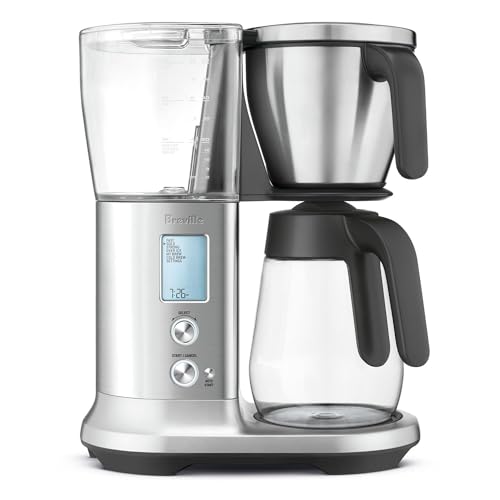
Breville Precision Brewer
Amazon listing: Breville BDC400BSS Precision Brewer Glass Carafe, Brushed Stainless Steel
Programmable drip brewer with adjustable temperature, flow rate and contact time
Cuisinart PerfecTemp 14-Cup Programmable Coffee Maker: Hotter Brewing for a Full Pot
The Cuisinart DCC-3200 is a 14-cup programmable machine with PerfecTemp technology, which brews at a higher temperature, and an adjustable warming plate. It is the sensible choice for a household that brews a full pot every day.

Cuisinart PerfecTemp 14-Cup Programmable Coffee Maker
Amazon listing: Cuisinart PerfecTemp 14-Cup Programmable Drip Coffee Maker, DCC-3200NAS
14-cup programmable drip coffee maker with PerfecTemp and adjustable warming plate
OXO Brew 8-Cup Drip Coffee Maker: Single Cup or Full Carafe
OXO's 8-cup brewer preheats water to the 194 to 205 F range that the Specialty Coffee Association prefers and can make either a single cup without pods or a full carafe. A timed warming plate keeps the carafe hot.

OXO Brew 8-Cup Drip Coffee Maker
Amazon listing: OXO Brew 8-Cup Drip Coffee Maker - Glass Carafe
8-cup drip coffee maker with single-serve and full carafe options
The Showerhead Matters More Than It Looks Like It Should
Temperature is half the story; even water distribution is the other half. Both machines above use a wide, evenly-perforated showerhead rather than the single-stream spout common on cheaper brewers. A single stream tends to channel water through one part of the coffee bed while leaving the rest of the grounds comparatively dry and under-extracted, a small mechanical difference that shows up directly in cup balance.
Flat-Bottom Baskets vs Cone Filters
Both machines here use flat-bottom filter baskets rather than cone-shaped ones, and that geometry shapes the cup. A flat, wider bed generally produces a fuller-bodied result, while a cone filter, closer to pour-over geometry, tends toward a brighter, cleaner cup. Neither is objectively better, it's a matter of preference, but it's worth knowing which style you're buying into before you pick a machine based on price alone.
Thermal Carafe vs Glass and a Warming Plate
Both brewers are also sold in a thermal-carafe configuration, and it's genuinely worth the small added cost if you don't finish a pot within the first twenty minutes. A glass carafe sits on a warming plate that keeps reheating the coffee from below, which slowly cooks it over the following hour, flattening flavor and pushing it toward a burnt edge the longer it sits. A thermal carafe sidesteps that entirely by insulating instead of reheating, holding a stable serving temperature for hours without the coffee ever touching a hot plate again after it finishes brewing.
A Certified Machine Still Needs the Right Grind and Ratio
SCA certification fixes the temperature and distribution variables, not grind size or dose. Aim for a medium grind, roughly the texture of coarse sand, and a ratio near 1 gram of coffee per 16 to 17 grams of water as a starting point for either machine. Our best coffee grinders 2026 guide covers grinders that hold a consistent drip setting, and our coffee scales guide covers the tool that turns that ratio into something repeatable instead of eyeballed.
Water Quality Is Doing More Work Than the Beans
Drip coffee is roughly 98% water by volume, so whatever's actually coming out of your tap shapes the cup nearly as much as the beans do. Heavily chlorinated or very hard water can flatten flavor and leave mineral scale building up inside a machine over months of use. See our water quality guide for what's worth filtering out and why, a detail that matters just as much on a $369 certified brewer as it does on the cheapest machine on a shelf.
Descaling Is the One Maintenance Task Worth Not Skipping
Mineral buildup from hard water gradually narrows the internal tubing both machines depend on to hold a consistent temperature and flow rate, so a regular descaling routine matters even for a certified brewer. A monthly-to-quarterly cycle with a food-safe descaling solution, run through an empty brew cycle and followed by a plain-water flush, keeps either machine performing at its rated temperature range for years rather than slowly drifting out of spec the way an unmaintained brewer eventually does.