

Most espresso troubleshooting starts with the grinder, the machine, or the beans. It rarely starts with water, even though water is roughly 98% of what's in the cup and the one variable running through a boiler on every single shot for years. Two products solve the water problem in genuinely different ways, and the right one depends less on which is "better" and more on what kind of machine you actually own.
Two Costs, Not One
Hard tap water carries dissolved calcium and magnesium that precipitate out as scale every time it's heated, gradually coating a boiler's internal surfaces and narrowing the tubing until temperature stability and flow both degrade. That's the mechanical cost, and it's the one most people picture when they think about water filtration.
There's a second, separate cost that has nothing to do with scale: magnesium and calcium ions are also what pull flavor compounds out of ground coffee during extraction, so water that's too mineral-heavy or too stripped-down changes the taste of the shot itself, independent of whatever it's doing to the machine. Our why water quality changes your coffee guide goes deeper on that balance.
The Plumbed-In Route: Filtering What Comes In

BWT Bestmax Premium S Water Filter Cartridge
Amazon listing: BWT Bestmax S Premium Water Filter for Espresso Machines, 5 Stage (S)
Five-stage filtration with calcium-to-magnesium ion exchange
The BWT Bestmax Premium S runs incoming water through five filtration stages, stripping chlorine and organic compounds while specifically exchanging calcium ions for magnesium ones rather than just removing minerals wholesale. Published testing behind BWT's magnesium technology shows that shift, more magnesium relative to calcium, measurably reduces bitterness and astringency in the resulting brew. It's built for machines with a direct water line or a larger reservoir seeing daily heavy use, where consistent filtration volume matters more than the higher upfront cost, which for a filter running through hundreds of liters of water is a fair trade for a boiler that's far more expensive to descale or replace than a cartridge is to buy.
The Manual-Fill Route: Building Water From Scratch

Third Wave Water Classic Mineral Packets, 12-Pack
Amazon listing: Third Wave Water Classic Light Roast For Brewing The Best Coffee, Classic Profile, 12 Single Gallon Sticks…
Mineral packets added to distilled water, no cartridge or plumbing needed
Third Wave Water skips filtration entirely and starts from the opposite end: distilled water, which carries essentially no dissolved minerals at all, gets a measured packet added back in to hit a specific, tested mineral profile. For anyone whose machine fills from a removable manual tank rather than a plumbed line, this is close to the simplest fix available, no cartridge to install, size, or remember to replace, just a packet dropped into a jug before it goes in the tank.
“Bad water doesn't just scale your boiler over years. It's changing how your shot tastes today, which is the part most people never connect back to the water at all.”
More Worth Considering
Breville Claro Swiss Water Filter: Claro Swiss Filters for Breville Models
These Claro Swiss filters are made for Breville machines and reduce chlorine, heavy metals and minerals, which means less scale and less descaling. This is the two-pack. Check that your Breville uses this filter before buying.
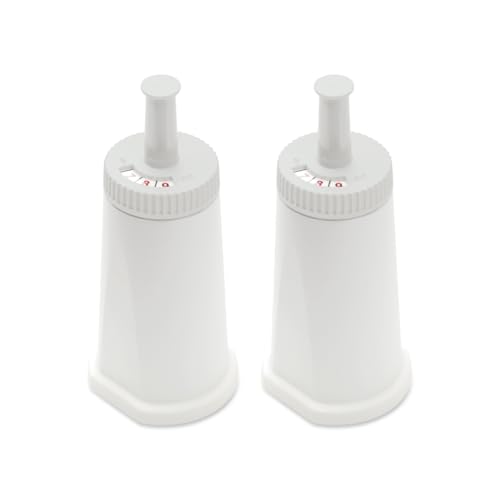
Breville Claro Swiss Water Filter, 2-Pack
Amazon listing: Breville BCC009 Claro Swiss Water Filter for Breville Models, 2 Pack
Claro Swiss water filter for Breville models, 2-pack
Brita Large 10-Cup Water Filter Pitcher: A 10-Cup Brita Pitcher
A filter pitcher can fill your machine's reservoir with better-tasting water by removing chlorine. It does not do the same job as a hardness-reducing espresso filter, so treat it as a taste upgrade and keep descaling.

Brita Large 10-Cup Water Filter Pitcher
Amazon listing: Brita Large 10 Cup Water Filter Pitcher, Includes 1 Filter, Bright White
10-cup water filter pitcher with one filter
Which Approach Actually Fits Your Machine
This isn't really a head-to-head comparison, since the two rarely compete for the same buyer. Check your owner's manual or look at the water inlet before deciding: a removable, hand-fillable reservoir generally has no fitting for an inline cartridge at all and is built around the distilled-water-plus-minerals approach instead. A direct plumbing line or a large built-in tank meant to be topped off occasionally rather than filled daily is what a cartridge system like the BWT is actually designed around. Retrofitting a cartridge onto a small manual-fill machine is usually unnecessary complexity for no real gain.
Skipping Filtration Isn't Free
Running untreated tap water through an espresso machine for months is the single most common cause of the scaling problems covered in our how to descale an espresso machine guide. Filtration doesn't eliminate descaling as a maintenance task altogether, since filtered water still carries a controlled amount of minerals by design, but it meaningfully stretches the interval between descaling cycles and keeps the flavor more consistent in between them.
Testing Before You Commit to Either One
A cheap water hardness test strip, the kind sold for aquariums and pools as much as for coffee, gives a rough read on how hard your specific tap water actually is before you spend money solving a problem you might not have. Soft municipal water might need nothing beyond basic filtration, while genuinely hard well water can justify the heavier BWT setup even feeding a manual-fill machine's tank, if the mineral load is high enough to scale quickly regardless of reservoir type.
The Bigger Picture
Water is usually the last variable home baristas think to fix, after the grinder, the machine and their technique, despite running through every shot equally regardless of how dialed-in everything else is. Our science of espresso extraction guide covers where water sits in that broader picture, and our best coffee scales 2026 guide covers the other precision upgrade worth making once water stops being the weakest link.